
As consultants supporting school and district MTSS implementation for the last fifteen years, the Continua team has embraced and improved our practice by increasingly learning from and utilizing the tenets of Implementation Science. We have witnessed educators slowing down to reflect upon Implementation Science practices and learning replicable steps that become smoother with each iteration. One of the most critical elements of the approach is that an implementation team, often a school leadership or district MTSS team, made up of distributive leaders, leads and oversees all 4 stages of the implementation process. With our guidance and support, they learn how to be an implementation team while also facilitating important change in their systems. While this requires an investment of ongoing time (we recommend at least two meetings per month for ninety minutes or more) and permission to slow down, especially in the exploration and installation stages, the results prove worthy of the investment and school leaders are willing to continue the investment over time to see continued results.
In recent years, the phrase Improvement Science has become common amongst professional organizations, publishers and leadership materials serving school Superintendents. This summer as new Superintendents began their tenure in some of our partner districts, we continued to hear about Improvement Science and noticed that the named efforts didn’t yet emphasize the importance of the implementation team like the use of Implementation Science does. This prompted us to articulate what these two approaches have in common, where they differ, and how they might best serve each other in the ideal.
Implementation Science: Why?
Implementation Science was introduced and refined in the medical field to solve the “research to practice gap” (Nilsen et al, 2022.) It is based on the premise that solutions to problems of practice exist within the research and evidence, but that practitioners aren’t yet familiar enough with those solutions to implement them as they were designed or with fidelity. When using Implementation Science in schools, some of its efficacy is due to how it supports collective understanding and involvement in the why. Why this policy shift? Why are we focused on this new practice, why are we even solving this problem?
When leaning on Implementation Science, the implementation team’s efforts in the Exploration and Installation stages include ongoing dialogue with their colleagues who will ultimately implement the changes. Ensuring that all practitioners understand the vision, goals, intended outcomes, problems of practice and decision-making procedures is a critical task of the implementation team. In order to make collectively agreed upon decisions about practice, all educators need answers to the “Whys” and the “How’s” of the change, and to have evidence of how their voice was included in the process to agree upon the identified solutions. This creates psychological safety when the implementation team (and those whom it leads) can name the drivers, communication practices and support systems for the initiative’s success.
Implementation science guides practitioners through four predictable stages of the work:
- Stage one (Exploration) is where: teaming foundations are established; problems of practice are explored, shared and discussed; and, decisions of what to attend to are made. This is where all those involved in the work have a voice and opportunity to make meaning of the focus and how it will impact and apply to their practice.
- Stage two (Installation) is the development of the resources, supports, agreements on success criteria, and language shifts to support successful implementation.
- Stage three (Initial Implementation) is the beginning of implementation. This is where Improvement Science enters the work, with its own cycle of implementation practices.
- Stage four (Full Implementation) is reached when 80% of more of the intended implementers are using the identified practices consistently and with fidelity. Student or community outcomes are being met and the use of the identified practice has become routine and part of the school or district’s shared approach
Improvement Science: Plan – Do – Study – Act
Improvement science arose in the industrial fields in the 1930s in response to the need to create conditions for consistent quality at scale during the industrial revolution. Engineers Walter Shewhart, Joseph Juran and William Edwards Deming published guidance that including the “Deming Cycle” (Plan-Do-Study Act) and the “Juran Trilogy” (planning, control and improvement) which informed and helped to grow the automobile industry’s assembly lines. Known eventually as Quality Improvement or QI, the practices were introduced into the medical field in the 1980s where they have continued to be refined and have an impact on service delivery. In Improvement Science, clinicians and medical professionals are focused on improving established practices related to their efficiency, safety, and/or quality. It assumes that the gap in patient outcomes is relative to the delivery of the practice and improvement is needed to iterate on that delivery (Nilsen et al, 2022.)
Improvement Science incorporates the Plan-Do-Study-Act (PDSA) cycle that many educators are familiar with when engaging as Professional Learning Communities (PLCs). It takes a systemic approach to improvement focused on PDSA cycles to ensure selected practices are successful through collaborative cycles of implementation, reflection, feedback, planning, and repeating this cycle until fidelity of practice and intended goals are achieved. Improvement Science in the medical field assumes that practitioners already are licensed to deliver Evidence Based Practices (EBPs) and are improving upon their quality. Within education, certification to teach does not necessarily equate to having validated knowledge of specific educational EBPs the same way that maintaining a medical license does. Educators at all levels are experienced practitioners who are skilled at delivering instruction and whose background or knowledge base in relation to current educational research can vary significantly. Educators spend most of their time instructing and often have very little to no time allocated for learning from current research and evidence.
Improvement science does not emphasize the role of an implementation team nor does it assume that any initiative will require “buy in” for successful implementation. Within education the importance of collective efficacy, system alignment of purpose and goals, and ensuring practitioner voice in decision making are all critical ingredients for successful implementation. Without investing in these elements first and jumping directly into PDSA cycles as Improvement Science suggests, schools are not well positioned to learn from the cycles and agree upon fidelity of any given practice. Furthermore, without engaging in root cause analysis and synthesizing multiple sources of data, teams of educators may not be in agreement of what problems they are solving or informed by any research into why a specific solution will (or won’t) work. How schools or districts determine which policies to implement and communicate about those choices are not included practices within the Improvement Science discipline.
MTSS Implementation in Schools: An Argument for Both Implementation and Improvement Sciences
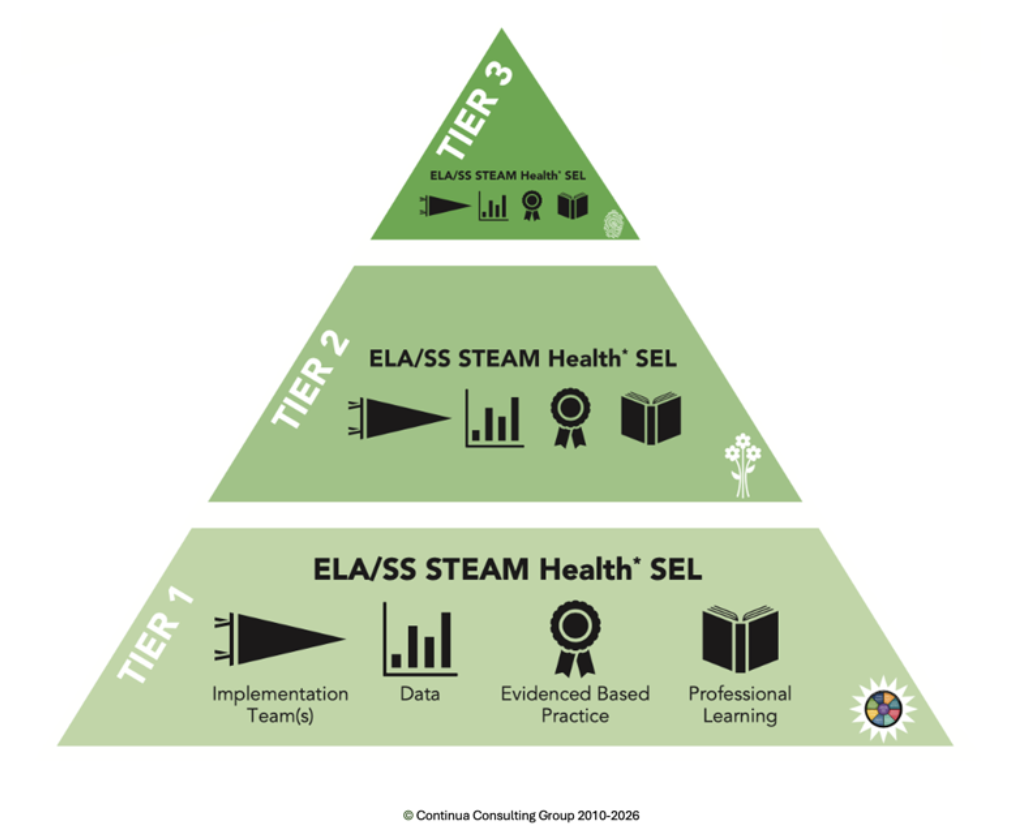
Shifting system practices in education towards an MTSS framework is complex work. Often practitioners lack a shared and agreed upon understanding of what MTSS is and how to foster it (Zhang et al, 2023.) MTSS is a framework that requires systematic and team approaches to decisions, utilizing a variety of data, to determine problems of practice and the use of evidence or research-based practices to address the gaps between current and desired outcomes. MTSS relies upon effective implementation teams at all three tiers. In our experience, calibrating and co-constructing success criteria for effective implementation teams is a critical step towards collective agreement upon the mechanics and routines of an MTSS approach.
Within the MTSS literature and working groups it is common to hear and witness challenges within the delivery of Tier 1 instruction. Statistically, we know that when less than 80% of students are demonstrating mastery, success or proficiency in any given domain or content area, then focus on the alignment and efficacy of Tier 1 instruction should become the priority. Even this concept sounds clear but in practice is often confusing or misunderstood. To get to alignment of Tier 1 practice requires clarity and expertise in the selected Tier 1 practices as well as focus on the fidelity of those practices being delivered. Implementation teams and science at Tier 1 serve to address this needed clarity.
Implementation science and improvement science are not the same. However, for effective implementation of any policy that relies on practitioners to shift or change behavior, they can be of great use to each other. Improvement Science or the PDSA cycles of improved practice are of significant value to PLCs and implementation teams in an MTSS framework once the practices of Implementation Science are known and utilized. By ensuring a foundation of Implementation Science practices, schools can then empower educator teams to explore the practices of Improvement Science to iterate and learn from each other’s practice.
Proactive and prevention strategies are the ultimate goals when implementing a Multi-tiered System of Support (MTSS) and MTSS practices should be sustainable regardless of leader or practitioner attrition. Understanding the application details and the symbiotic relationship between implementation and improvement sciences can support sustained improvement in schools and school districts. By utilizing the evidence-based approaches of both implementation and improvement science cohesively educators can build successful MTSS frameworks in any system.
Citations:
Nilsen P, Thor J, Bender M, Leeman J, Andersson-Gäre B and Sevdalis N (2022) Bridging the Silos: A Comparative Analysis of Implementation Science and Improvement Science. Front. Health Serv. 1:817750.
Zhang, J., Martella, R. C., Kang, S., & Yılmaz Yenioglu, B. (2023). Response to intervention (RTI)/multi-tiered systems of support (MTSS): A nationwide analysis. Journal of Educational Leadership and Policy Studies, 7(1), 1–26.
About The Authors

Subscribe
Signup to receive new blog posts and podcast episodes sent to your email.